Recommendation
Do not investThe conclusion at the ₹1,828.10 NSE close on 10 July 2026; it is a dated thesis, not a current market call.Individual investment research · Masters’ Union Investment Fund
APSEZ investment thesis
Can a very good business still be an unattractive investment at the price on offer?
Result so far
I submitted a two-page investment-committee thesis with a clear decision, segment valuation, peer comparison, scenarios, catalysts and invalidation conditions. It formed part of my successful application to the Masters’ Union Investment Fund, where I was selected for the Listed Equities team after the thesis, group discussion and interview stages.
My contribution
I researched the company and direct peers, built the valuation and scenario logic, wrote the thesis and made the final call. I used public information available by 10 July 2026 and separated company disclosures from my own assumptions.
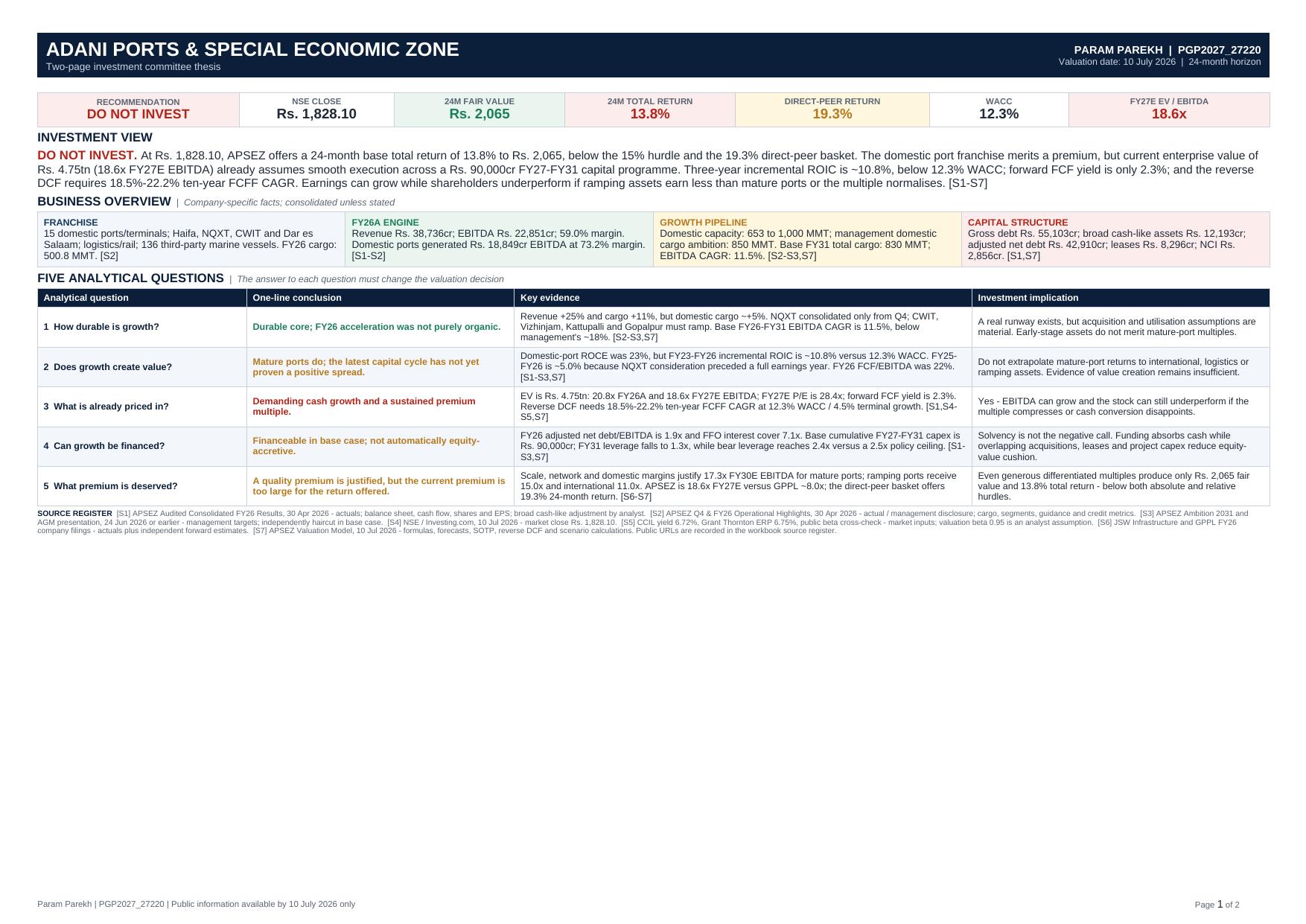
The first page of the two-page investment-committee thesis submitted on 10 July 2026.
Open full-size image ↗01 / The problem
Where it started.
For the Listed Equities research-team application at the Masters’ Union Investment Fund, I had to turn a large public-information set into a two-page decision. Adani Ports and Special Economic Zone had scale, strong domestic port economics and a large growth plan. The harder question was whether the market price already assumed too much of that growth would arrive smoothly.
The decision
Recommend ‘do not invest’ at ₹1,828.10. The base case reached ₹2,065 over 24 months, a 13.8% total return—below both the 15% hurdle and the 19.3% direct-peer basket.
The answer I did not expect to prefer
The company had a lot to like: 15 domestic ports and terminals, a 59% FY26 EBITDA margin and a large capacity runway. That made it easy to write a positive company description. It did not answer whether the share offered enough prospective return.
My base case allowed for substantial growth and still reached only 13.8% total return over 24 months. The direct-peer basket was higher, and the reverse DCF required very demanding cash-flow growth. The recommendation therefore stayed ‘do not invest’ even though the operating story remained attractive.
Where the judgement sat
The model did not give every asset the same multiple. Mature Indian ports received the highest valuation; ramping and international assets received lower multiples for execution, concession, country and currency risk. Logistics and marine operations were valued separately too.
The memo also kept solvency separate from value creation. Base-case leverage looked financeable. My concern was that a ₹90,000 crore capital programme could absorb cash while new assets earned less than the mature franchise.
02 / The approach
How I worked through it.
- 01
Define a 24-month decision horizon and a 15% absolute return hurdle.
- 02
Reconcile reported cargo, segment earnings, debt, leases, cash-like assets and the FY27–FY31 capital programme.
- 03
Test five questions: growth durability, value creation, what the price already assumes, financing capacity and the premium the franchise deserves.
- 04
Value mature ports, ramping ports, international assets, logistics, marine operations and other interests separately in an FY30E sum-of-the-parts model.
- 05
Compare bull, base and bear operating cases, then state the evidence that would change or invalidate the recommendation.
03 / The evidence
What the work produced.
Base fair value
₹2,06524-month FY30E sum-of-the-parts value after net debt, leases and minorities.Base total return
13.8%Below the 15% hurdle and the estimated 19.3% direct-peer basket.Capital test
10.8% vs 12.3%Estimated three-year incremental ROIC versus WACC; a central reason for caution.The linked two-page PDF is the submitted output. Page one contains the recommendation, business overview, five analytical questions and source register. Page two contains the segment valuation, scenarios, peer comparison, catalysts and explicit conditions for changing the call.
04 / Looking back
What I took away.
The interesting part was saying no to a business I liked. APSEZ’s domestic franchise looked strong, but the entry multiple, capital intensity and return on new investment left too little room for things to go wrong. Writing the opposite case helped me separate admiration for a company from the return available to a shareholder.
- A growing business can still disappoint shareholders when the starting valuation already prices in smooth execution.
- Segment-level valuation made the difference between mature, ramping and international assets visible.
- A useful thesis states what would change the view instead of defending one conclusion forever.
What I would measure next
Track the company’s results against the organic cargo, cash conversion, leverage and incremental-return thresholds in the thesis. Rebuild the peer bridge with updated market values before using the memo for a current decision.
Scope & confidentiality
This was an individual Masters’ Union Investment Fund application submission based on public information available by 10 July 2026. All values and conclusions are tied to that date. No capital was deployed through this submission.